


In Japan, there are several different types of Hanko that are used for a variety of purposes. Most Japanese people have at least one or two, but often have three or more. It’s helpful to think of them as special passwords that you can use for different occasions. Here are the different kind of hanko that Japanese individuals use:
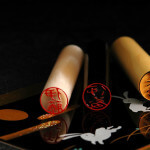
Mitome-in – 認め印
Mitome-in is your standard, unregistered hanko, carved out of a hard material like wood, stone, metal or acrylic. The word “mitome” comes from the word meaning to acknowledge or accept. For most people coming to Japan in the short term, this should suit your needs for signing basic contracts, opening bank accounts and getting a cell phone.
Mitome-in can be indispensable for office and paperwork. Office workers, teachers, graduate students and research assistants have reported that they keep their mitome-in with them because they use it frequently.
Ginko-in – 銀行印
When using a hanko with a bank, the bank will register the mark to your account, making it official for use with that bank. This is called ginko-in (銀行印), or “bank-stamp.” Whenever you use your ginko-in, the mark is compared to the registered impression to ensure it is the official mark.
The only difference between a mitome-in and a ginko-in is that the ginko-in is registered to your bank account. However, while an unregistered mitome-in can pretty much have anything on the seal, your bank may have more restrictions. Generally, if you include your first or last name in your seal, you should have no trouble getting it registered with your bank.
As long as it meets the bank’s requirements, you can use the same hanko as your mitome-in and ginko-in. But because the ginko-in has this added power, most people use a separate hanko from their casual mitome-in to register with their bank account, and keep it in a safe place. If they have multiple bank accounts, they may even have separate ginko-in for each bank.
In cases when you use your ginko-in, you must also present your bank book. Although it seems more convenient to keep your ginko-in and bank book together, Japanese people tend to store them separately for added security.
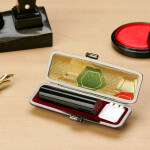
Jitsu-in – 実印
Your jitsu-in is your most powerful hanko. It has this power because it must be registered with the local government, and the design must be unique. No two jitstu-in are the same, even if they contain the same characters. Because it has this power, most people choose a larger hanko to use for their jitsu-in, and use their full name on the seal.
Think of it as your signature + fingerprint: it is as official as you can get. Although you can use your jitsu-in for less official uses, it’s common for people to reserve their jitsu-in for only a few formal situations, such as:
- To seal an agreement to purchase or sell real estate or something of similar value.
- To seal a loan agreement like a mortgage.
- To register your owned real estate or properties to your municipal administration.
- To seal a joint surety agreement.
- To seal any other agreements that are related to your rights or liability for relatively large amount of money or high-value properties when you need to prove your identity.
For occasions that require you to use your jitsu-in, you’ll also need to present a document called a proof of registry, issued by your local government office. This is meant to prove that the seal you are using is indeed registered to you.
The important thing to remember with jistu-in is that the name on the seal must match your legal name in Japan. If you wish to write your name using katakana or kanji on your jitsu-in, you must register it as an official alias (通称, tsūshō) with your local government. Your alias will be listed on your ID cards and proof of registry documentation. If your seal doesn’t match your legal name or alias, you will be unable to register the hanko as jitsu-in.
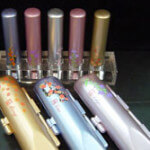
Self-Inking Stamps – シャチハタ
Shachihata is actually a brand name (like Kleenex) that has become synonymous with self-inking rubber stamps. These stamps are used for everyday things like signing for deliveries, and marking papers for basic office and school work. Because they don’t require an ink pad, shachihata can be very convenient, and for many uses can be used interchangeably as mitome-in. Many people keep a shachihata in their genkan (doorway) for accepting deliveries.
However, since the stamp is made from a soft material, the mark it makes may vary from one impression to the next, so it cannot be used for any official purpose that requires a registered seal. For this reason, shachihata cannot be used as ginko-in or jitsu-in.
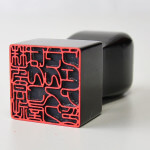
Other Hanko – その他の判子
Hanko in various forms have worked their way into many facets of Japanese culture. One example is teisei-in, a tiny hanko used to acknowledge who made/approved corrections on a legal document. In the US, for example, this would usually be noted with one’s initials.
For mitome-in, hanko don’t have to be just for practical use and office work alone. You can get a hanko carved with just about any fun design you’d like, and some people even incorporate cute drawings and characters into their unofficial seals. If you are interested in a custom hanko design, contact us for more information.
Artists and calligraphers also use one or several hanko to sign their work. These are usually called “rakkan-in.” These hanko may contain the artist’s real name in full or in part, or their “artist name” or “pen name,” which is either chosen by them or bestowed by their master. These are known as “artist chops” in English.
Lastly, hanko aren’t just for people. Restaurants may create a special stamp to mark receipts or point cards for their customers. Many temples in Japan offer goshū-in, a combination of stamps and calligraphy, to commemorate your visit. Some people go on pilgrimages to collect these stamps on beautiful scrolls or in elegant books called goshūinchō or nōkyōchō, which become treasured souvenirs and even heirlooms.
On the practical side, any legal entity hoping to do business in Japan must have their own set of hanko which are registered to the local government to give them the legal authority to sign contracts and other documents. Click here for more information on hanko for business.